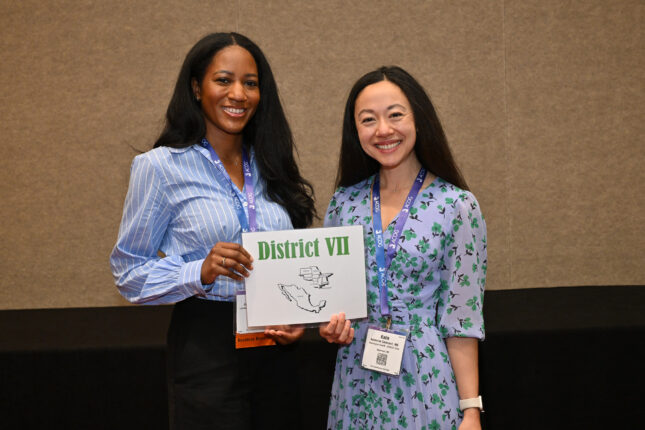
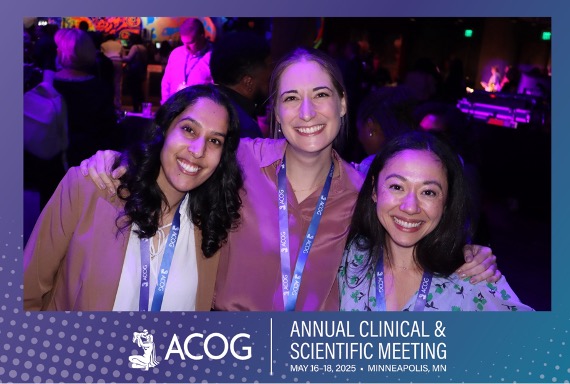
Dr. Katie Carbonell, PGY-3 WashU Medicine OBGYN resident, was a Resident Reporter at the 2025 ACOG Annual Clinical & Scientific Meeting. She shares her experience of going to the meeting below.
“Attending the 2025 American College of Obstetricians and Gynecologists (ACOG) Annual Clinical & Scientific Meeting (ACSM) was a deeply inspiring experience—an energizing convergence of the nation’s leaders in women’s[1] healthcare. As a participant in the Resident Reporter Program, I had the unique opportunity to fully engage in this educational, networking, and advocacy-rich environment. This experience not only broadened my clinical knowledge but also reaffirmed my passion for our specialty and my commitment to shaping its future.
Through the Resident Reporter Program, I was immersed in the heart of ACOG’s mission. I met and learned from experts who have shaped the field. Their insights, stories, and candid reflections offered a profound understanding of what it means to be a compassionate, skilled, and impactful physician. Beyond these professional connections, I also built friendships with fellow Resident Reporters. We shared experiences, aspirations, and perspectives, and I hope to nurture these bonds as we grow into the next generation of leaders in obstetrics and gynecology.
One of the most powerful aspects of the Resident Reporter Program is its ability to increase resident involvement in ACOG, which is often limited by financial and logistical barriers. By removing these obstacles, the program opens doors for young physicians to participate in the dialogue shaping our field. I left the conference feeling empowered—not only to be more active within ACOG but to advocate for my patients and colleagues at a national level.
The sense of shared purpose at the ACSM was palpable. Our field is united by a deep commitment to providing compassionate, evidence-based care. Yet, we face increasingly difficult challenges. Legislative threats to reproductive autonomy, including restrictions on pregnancy termination, are mounting. At the same time, the erosion of Medicaid coverage jeopardizes access to care for our most vulnerable patients, exacerbating disparities in maternal and infant morbidity and mortality, as well as in cancer screening and treatment outcomes. These realities demand our vigilance and collective advocacy. Our involvement in organizations like ACOG and the American Medical Association (AMA) is not optional—it is essential. Our voices are stronger together, and if we do not speak up, who will?
One of my most meaningful takeaways from the Resident Reporter Program was the recognition that there is no single path to leadership or impact in our specialty. Many of the physician leaders I admire did not follow a linear trajectory. They said “yes” to unexpected opportunities, pivoted when they felt stagnant, and carved out careers that aligned with their unique strengths and evolving interests. This perspective was both validating and liberating. It reminded me that growth often lies beyond our carefully laid plans, and that being open to change is a strength, not a weakness.
Wellness emerged as another central theme of the meeting—a timely and vital topic. In recent years, the conversation around physician wellness has gained momentum, and rightly so. As caregivers, we cannot pour from an empty cup. Cultivating a culture of wellness is not only essential for our own health but also for the quality of care we provide. As I consider my future practice, I am committed to creating an environment where wellness is not an afterthought, but a priority.
The educational content at the ACSM was exceptional. I have already applied insights from several sessions to my daily clinical work. The lecture on menstrual cycle and mood enhanced my ability to counsel a patient with PMDD, offering her clarity and validation. In my region, where syphilis prevalence is high, the syphilis panel discussion gave me the confidence to interpret abnormal RPR titer trends more effectively. Career-focused sessions, such as the Contract Negotiation lecture, equipped me with practical tools I’ll soon use as I navigate job interviews and contract discussions for generalist practice.
My experience at the ACSM through the Resident Reporter Program has been nothing short of transformative. It deepened my clinical knowledge, strengthened my professional network, and reinforced my resolve to advocate for equity and excellence in women’s healthcare. Most importantly, it reminded me that I am part of a passionate, resilient community—one that fights every day to ensure that all patients receive the care they deserve.
I am grateful for this experience and excited for what lies ahead. I look forward to remaining actively engaged with ACOG and to attending future ACSM conferences, where learning, advocacy, and community converge to move our field forward.”
[1] The term “women” is used in this document with the understanding that this term includes all individuals who may need gynecological and reproductive health services, including non-binary, transgender, and gender-diverse people.
Thank you to Dr. Carbonell, who shared her experiences with our department.